
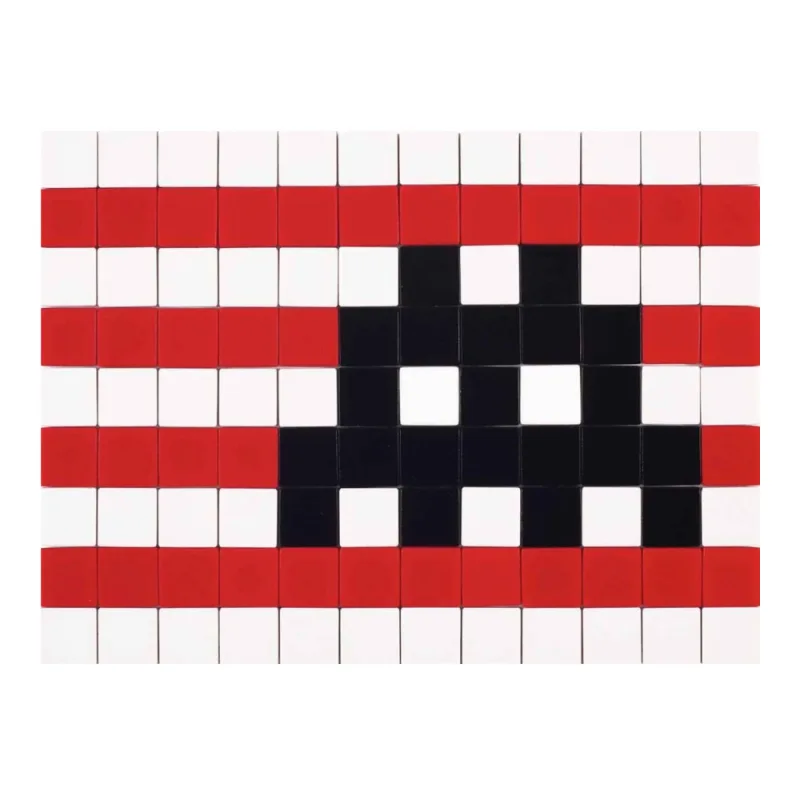
Invader
There are artists who are discovered in a gallery. Invader, on the other hand, is first discovered on the street.
In Paris, it’s enough to take a few minutes to spot one of his mosaics. With more than 1,500 works installed in the capital and more than 4,000 worldwide, Invader has literally transformed cities into giant playgrounds.
These small mosaic figures inspired by the world of video games and pixel art are now part of our urban landscape. Their work can even be found in space, with a work being sent aboard the International Space Station.
Yet behind these works that can be discovered in the course of a street walk is one of the most emblematic artists of contemporary street art.
I discovered Invader when I returned from Morocco in 2012. A colleague told me about the Flash Invader app, which allows you to go out and search for the mosaics installed in the streets, take photos of them, and earn points through a ranking among enthusiasts.
At first, I must admit that I was quite intrigued by this approach. I saw these little characters appearing everywhere in Paris, without really understanding who was behind them, why these works were being installed there, or what the meaning of this invasion was.
It is precisely this mystery that made me want to go further.
As I discovered the world of Invader, I gradually realized that this wasn’t just an artist pasting mosaics on the street. Behind each installation lay a genuine reflection: investing in urban space, transforming our view of the city, and creating a direct connection with the public.
A few years later, I took the plunge myself. I went for a walk in Paris with a simple idea: to discover a new neighborhood, open the app, and start searching for the Invader mosaics.
And that’s when I realized the incredible strength of his concept.
Invader does not just create works of art. He creates an experience.
It transforms our cities into playgrounds, our walks into treasure hunts, and each new mosaic discovered becomes a new adventure.
We no longer walk around in quite the same way: we look at the walls, the buildings, the details of the city, with a constant desire to stumble upon a new mosaic.
What’s fascinating about Invader is that this approach affects absolutely everyone.
Over the years, a real community has formed around his work. We share our next outings, weekends, or trips with enthusiasts, often choosing a destination because it is also "invaded" by the artist's mosaics.
Exploring a new city becomes a new way of traveling: we prepare our itinerary, identify the mosaics present in the city, and set off to discover these small works installed in public spaces.
What is incredible is to see that this passion brings together all generations. Children go on a mosaic hunt with their parents and grandparents, each with the same pleasure of discovering a new work of art.
Invader managed to do something rare: create an art form that is free and accessible to everyone, right in the street.
You don't need to have any special knowledge of art. You don't need to go to a museum. Just walk around, look around, and be surprised.
Today, when a new mosaic appears in a city, enthusiasts get together to discover it. Some even organize real "Flash Tours", trips or weekends specially prepared to follow in the footsteps of the artist and discover his new creations.
I myself travel to discover some of his works, to prepare itineraries, and to explore a city in a different way thanks to his work.
Of course, Invader has become a major figure in global street art. His work is now recognized by both the general public and international collectors alike. He is one of the most sought-after urban artists in the world, with works currently fetching exceptional sums on the art market. Some of his creations have even exceeded one million euros at auction, proving the place he now holds in the history of street art.
His use of the mosaic, directly inspired by the world of pixel art and video games, has created an instantly recognizable signature.
But beyond the technique, what fascinates me about him is his ability to create a connection between the work, the city, and the audience.
He managed to transform an ancient technique like mosaic into a contemporary language that is immediately understood by all generations.
That’s also what we see at Galerie Montorgueil. We present several artists who work with mosaics, pop culture, and street art, but Invader remains a unique artist.
He is one of the artists who changed the way we look at the city.
And that’s exactly what I like to share in the gallery: artists capable of creating an immediate emotion, provoking discovery and inspiring people to go further.
With Invader, art is not just hung on a wall.
It is everywhere around us.


