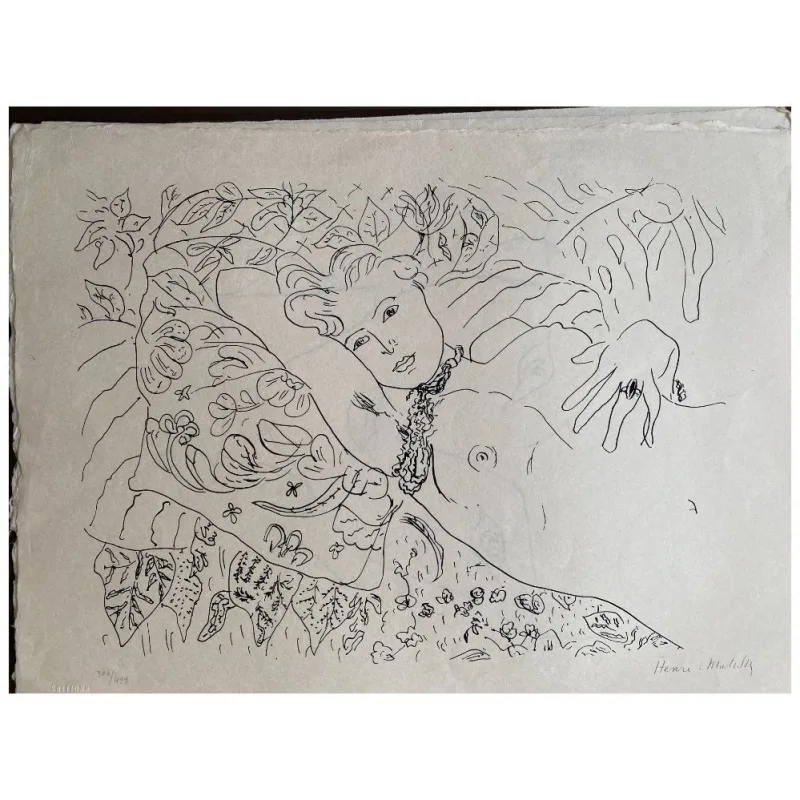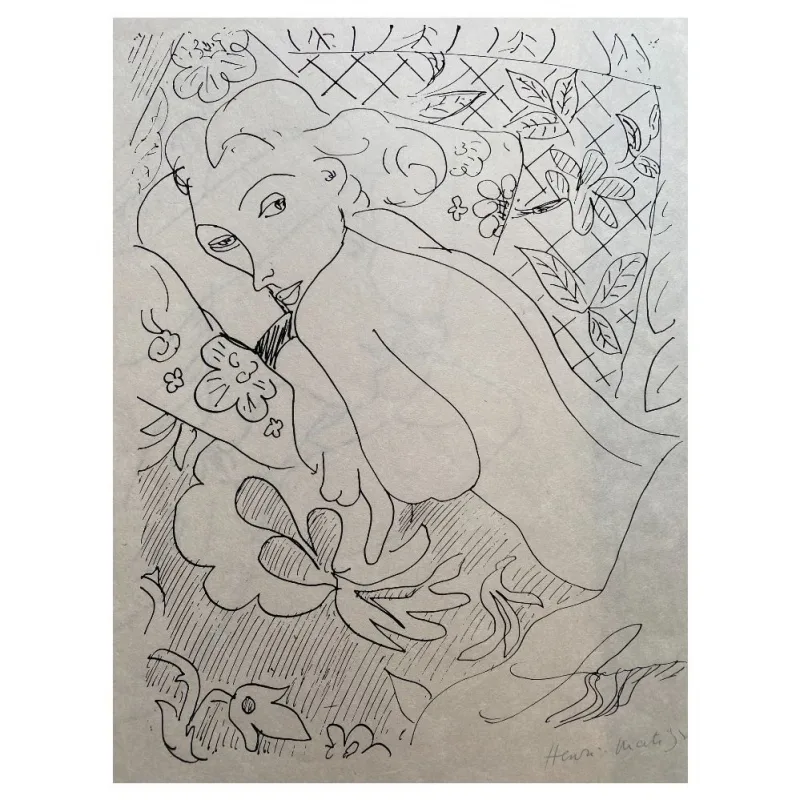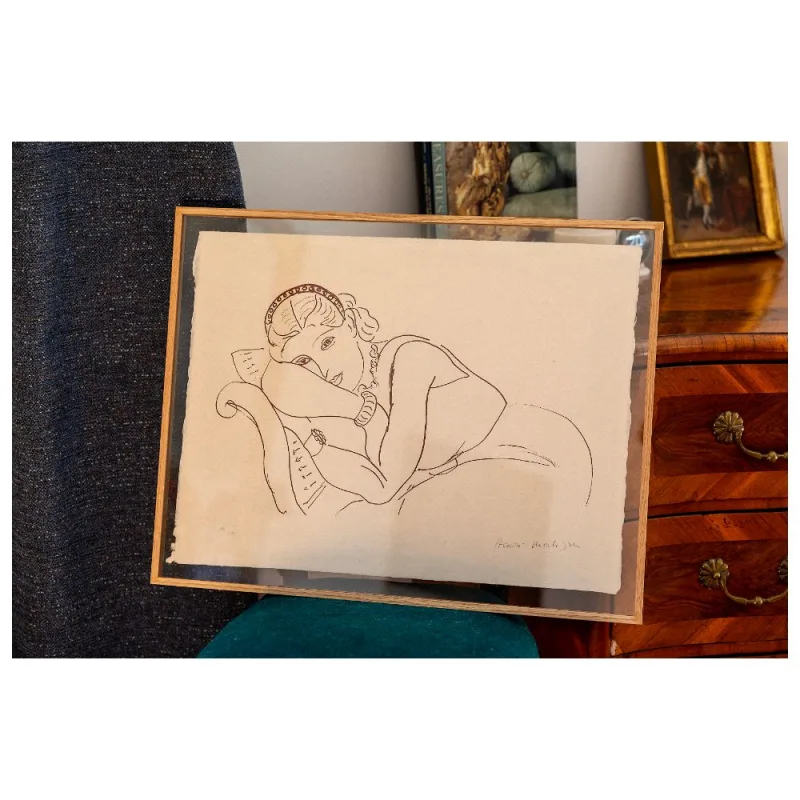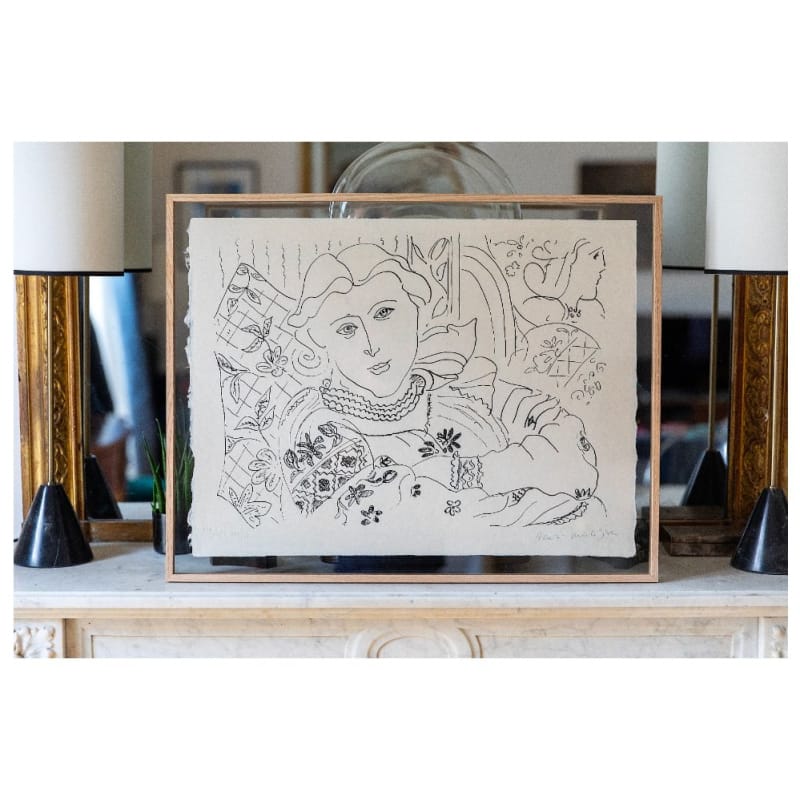
Henri Matisse
Henri Matisse, born in 1869 in Le Cateau-Cambrésis, France, is one of the pillars of modern art. His career, spanning several decades, saw the evolution of numerous styles and techniques, but he is best known for his revolutionary use of color and his bold compositions that marked Fauvism and beyond.
After initially studying law, Matisse discovered painting at age 20, a revelation that led him to abandon his legal career to dedicate himself to art. He studied at the Académie Julian and the École des Beaux-Arts in Paris, where he quickly developed a style that set him apart from his contemporaries. Early in his career, Matisse was influenced by Neo-Impressionism and Symbolism, but it was his encounter with Post-Impressionist Vincent van Gogh that definitively shaped his approach to color.
Matisse became one of the leaders of Fauvism, a movement characterized by its scandalously bold use of non-naturalistic colors. His 1905 work «The Green Line» (or «Portrait of Madame Matisse»), with its face divided by a green line, is one of the most famous examples of this period. Fauvism, though short-lived, is crucial to the evolution of modern art, freeing color from its descriptive function and transforming it into a means of pure expression.
Beyond Fauvism, Matisse continued to explore and refine his passion for color and form. During the 1910s and 1920s, he became interested in order and structure, influenced by his travels in North Africa and his encounter with examples of Islamic and Byzantine architecture. This period is marked by more restrained and geometric works.
One of Matisse's most significant innovations occurred later in his career with his cut-outs. Facing health issues that physically limited him, he began cutting shapes from paper previously painted with gouache, creating vibrant compositions that combined painting and sculpture. This technique culminated in works like «The Parakeet and the Mermaid» (1952) and is considered a major breakthrough in his quest to express joy through art.
Matisse's legacy is profound and lasting. Not only did he influence his contemporaries, but he continues to inspire generations of artists, designers, and creators worldwide. His works are exhibited in major museums and serve as a constant reference for the study of color and form in art. Matisse passed away in 1954, but his impact on modern art is indelible, characterized by a relentless pursuit of innovation and a celebration of beauty in its purest forms.